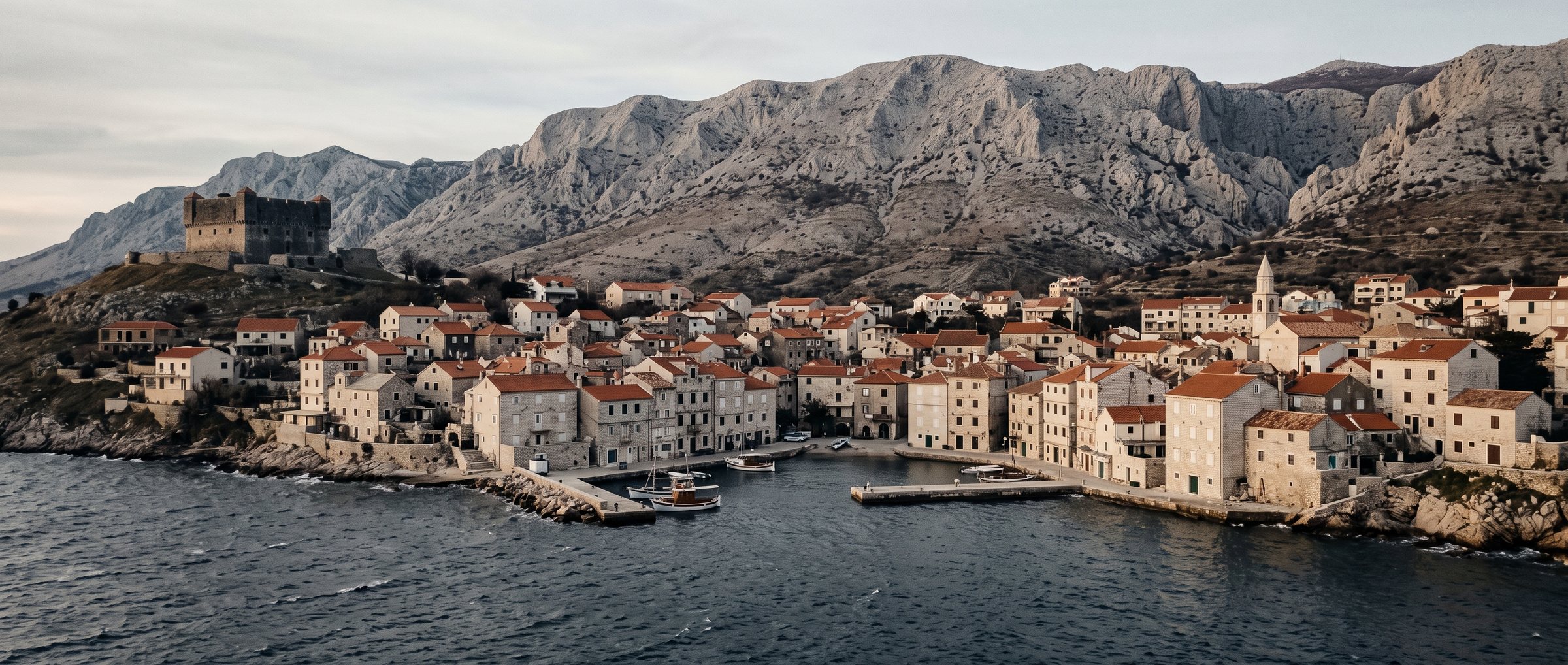
One woman, four families, and the mountain they were planted on.
An evidence-first archive for Hedviga “Seka” Blažević — born at Senj in 1926, dead at Johannesburg in 2001 — and for the Blaževići, Žubrinići, Papići and Prpići who made her.
Illustration, not a photograph: a generated image of the northern Adriatic coast, standing for Senj under the Velebit. Every document reproduced on this site is the real scan. Why the distinction is laboured here →
This archive begins with one woman — Hedviga “Seka” Blažević, born at Senj on 3 August 1926, married to Ivan Anton Defranceski, and dead at Johannesburg on 30 October 2001 — and works outward into the four families that made her: the Blaževići of Smokvica Krmpotska, the Žubrinići of Otočac, the Papići of Senj and Selce, and the Prpići of Krivi Put.
It reaches nine generations and 70 named ancestors, the earliest born about 1717. Everything here is either sourced, reasoned in the open, or labelled as something the family says and the record does not yet confirm.
Start with Hedviga The spine, nine generations What is still unproven
It is a public archive with one rule: living people are absent from this build — not hidden, not gated, never written into the site at all. And a second rule, which is harder: every claim says how well it is known. Documented Inferred Family lore
Where this family can actually be put
Almost all of it inside one mountain county, and then Port Pirie. Every dot is a place this archive can put a named person in, and its size is how many stand there. The biggest are labelled; the colours are this archive's own regions. The coast and the borders under them are real — Natural Earth, clipped to this frame — so a dot can be read as somewhere rather than as a position in an empty box.
What they were living under, and what they were up against
Senj and the Krmpotska mountains were never one country for long: Frankopan and Uskok, then Venice at the water's edge, then the Habsburg Military Frontier, which governed this family as soldiers of the border rather than subjects of a province. Red above the lanes is this family. Ochre below is the wars, plagues and regime changes they were lived through. Hover or tab any marker and it tells you what it is.
Hover or tab through a marker — red above for this family, ochre below for the world around it.
The spine
Eight generations of Blažević men, from a boy born about 1750 in a village that had existed for barely a century, down to Hedviga at Senj in 1926.
3 children recorded show ↓ hide ↑
Brothers and sisters · 6 show ↓ hide ↑
Her line has no archive of its own yet, so the register names her parents and nobody else.
7 children recorded show ↓ hide ↑
Brothers and sisters · 12 show ↓ hide ↑
The joint here will not bear weight. Still no birth or death date — but no longer undocumented: the 1920 marriage register names him as Ljubomir's father.
4 children recorded show ↓ hide ↑
Brothers and sisters · 7 show ↓ hide ↑
5 children recorded show ↓ hide ↑
Brothers and sisters · 1 show ↓ hide ↑
Her line has no archive of its own yet, so the register names her parents and nobody else.
2 children recorded show ↓ hide ↑
Brothers and sisters · 3 show ↓ hide ↑
Her line has no archive of its own yet, so the register names her parents and nobody else.
4 children recorded show ↓ hide ↑
Brothers and sisters · 1 show ↓ hide ↑
Her line has no archive of its own yet, so the register names her parents and nobody else.
The joint here will not bear weight. No source of any kind attached.
2 children recorded show ↓ hide ↑
Brothers and sisters · 3 show ↓ hide ↑
Her line has no archive of its own yet, so the register names her parents and nobody else.
The joint here will not bear weight. No source of any kind attached.
4 children recorded show ↓ hide ↑
Generation three is now documented. The Senj marriage register of 8 December 1920 names Ljubomir's parents as Juraj Blažević and Tereza r. Žubrinić — closing the join this archive was built around. Juraj himself is still undated, and nothing yet links him to Toma above. See the open questions →
Recently found
An archive that never changes is not being worked on. Most of what follows is this one becoming less certain rather than more — which is what happens when somebody actually reads the registers behind a family tree.
| 10 September 2026 | Antić and Papić are one family, and a by-name explains it The two surnames never interleave in 15,643 people. They touch at one man — and the 1806 Vrbnik register underlines Papa as the household's nadimak. |
| 10 September 2026 | A man born after his own granddaughter Caetano Bacchi is dated 1779; his daughter's daughter was born in 1781. Two years cannot hold two generations, and two more ancestors go with it. |
| 10 September 2026 | Two Žubrinić couples of the same two names, a generation apart One tree couple is given sons born 1834 and 1880. A Senj marriage of 1910 names the later son's parents in the same words — so the tree has merged two men. |
| 10 September 2026 | Hedviga sang at the Hotel Therapia, and it is still standing The only thing anyone has ever said about what she did. The hotel opened at Crikvenica in 1895 and was renamed Kvarner Palace in 2013 — the family believed it had closed. |
| 10 September 2026 | Twenty-two years of her life are missing Senj in April 1953, South Africa in April 1975 — and an entire country in between, known from two words on a later record. |
| 10 September 2026 | The Latin case-endings were the priests, not a transcriber One hand at Karlobag writes Nomen Joannis Georgij in 1777 and nomen Oliva Maria in 1781. Scribal caprice, not error — and the ending tells you which record the person came out of. |
| 10 September 2026 | Four sorting buckets were being published as ancestors “1800-1830 Birth — Selce Papić (Papa)” and three like it had person pages and children attached. Found by a new self-consistency check. |
| 9 September 2026 | Smokvica 114 is a zadruga, not a household A control document puts a first cousin at the same number. The house places Juraj in Ilija's kin-group; it cannot name his father. |
Kept by hand, as at 13 September 2026. A list like this rots quietly, so it carries its own date: if that is far behind the commit log, the log is the honest record and this is not.
Everything this archive got wrong → What has been searched →
The families who married in
Nineteen families and forty-five direct ancestors — and not one of them here because of a surname. The marriages, in full →
Her great-grandparents4
- Pilipic4
- Shambul Marić2
- Antić Papić1
- Pećanić1
Her great-great-grandparents4
- Uroda4
- Antić3
- Jelličić3
- Orešković / Oreskovic2
Five generations back6
- Gerkacs (Gergacs)3
- Sekula3
- Brozović2
- Loncaric2
- Findrić1
- Smojver1
Six generations back4
- Bacchi3
- Luckinić3
- Smojver Vukić2
- Tomljanovic2
Seven generations back1
- Pekass (Pekkas)3
What this archive has established
They are Bunjevci, and that is not a small detail
Smokvica Krmpotska and Krivi Put were not old Croatian villages. They were founded — settled between about 1605 and 1647 by Bunjevci Krmpoćani who fled the Ottoman advance from Krmpote near Zemunik in Dalmatia and were planted in the Senj mountain by the Military Frontier. Two of Hedviga's four grandparental lines come out of those settlements. The settlement →
A railway that went somewhere else
In 1873 the Karlovac–Rijeka railway bypassed Senj, and the port that had made the town died with it. The occupations in this family are the aftermath: nadničar — day labourer; trhonoša and bremenar — load-carrier and porter; mornar — sailor. Then the tobacco factory, then the boats out. Senj →
One name, three spellings, three countries
Žubrinić in Otočac. Xubrinich in the Venetian-era registers, where X wrote the sound Ž. Zubrinich at Port Pirie in South Australia, where Ivan Žubrinić landed about 1884 and every one of his children was registered under the anglicised form. The name changed at the border and never changed back. The names →
A brother with two deaths and no grave
Oto Blažević (1923–1945), Hedviga's brother, died at twenty-two. The family carries two irreconcilable accounts of how — a snakebite, and the war in Slavonia — and a photograph of the family grave now corroborates the second witness in precise detail, down to who was added to the stone half a century later. The brother →
The archive in numbers
Every one of these is a link to the page that earns it.
What is still missing
19 open, 9 answered — and the answered ones are kept so that the change stays visible. The archive's central doubt, who Ljubomir's parents were, was closed by the Senj marriage register of 8 December 1920; what remains is set out with the document that would settle each one beside it. Open questions →
The most valuable thing anyone can send this archive is a correction. The second is a document that closes one of these. Where a record has been seen it is cited; where it has not, the claim is marked. See Method.